Prof. Dr. AbdulMahdi Kadhum Nasser
College of law/ university of Al-Qadisiyah
Assistant lecturer Hider Salah Gatea
College of law/ university of AlQaqisiyah
Haider.gatae@qu.edu.iq
abdulmahdi.naser@qu.edu.iq
Abstract
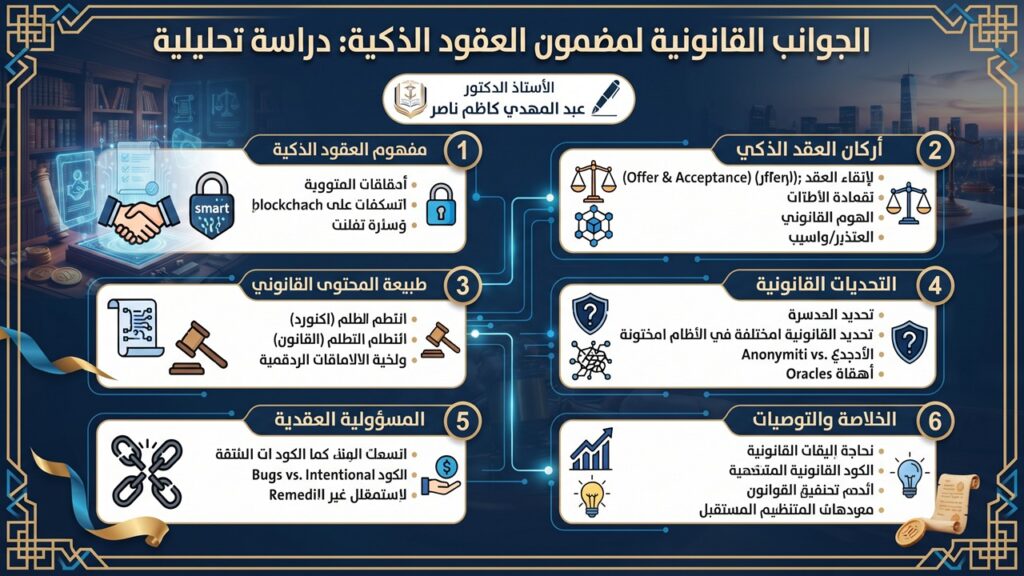
In today’s digital era, smart contracts—self-executing agreements based on blockchain technology—are reshaping the traditional concept of contractual content. Unlike conventional contracts, which are written in flexible legal language and interpreted by courts, smart contracts are defined by rigid, automated code that executes without human intervention. This shift poses significant legal challenges concerning the notions of intent, consent, and fairness.
The research highlights two contrasting frameworks: traditional contracts, rooted in mutual intention and interpretive flexibility, and smart contracts, which rely on deterministic code, often disregarding context or unforeseen circumstances. Classical legal systems allow judges to interpret, modify, or invalidate contracts based on equity or public policy. However, smart contracts lack this adaptability, as demonstrated in cases like The DAO Hack (2016), where code was executed strictly despite ethical concerns, embodying the principle that “code is law.”
The study further analyzes how smart contracts redefine the function of contractual content—from a legal expression to a technical enforcement mechanism. While this enhances operational efficiency, it eliminates judicial oversight and risks unjust outcomes for weaker parties.
Key findings include the transformation of content into executable code, the erosion of judicial roles, and the need to adapt classical legal concepts. To address these issues, the study recommends legislative reforms that recognize smart contracts as a distinct legal category, the integration of algorithmic fairness, and the creation of digital arbitration platforms. Ultimately, it calls for a reimagining of legal actors and norms in light of emerging technologies, balancing innovation with fundamental legal protection.
Keywords: Smart Contracts, Legal Interpretation, Blockchain, Algorithmic Fairness, Judicial Oversight
https://iajphss.us/wp-content/uploads/2026/09/م.-م.-حيدر-صلاح-كاطع.pdf
لتحميل البحث اضغط على الرابط